Egotar Tunes Rocket Man - Something - My One and only Love - Attics Of My Life |
|||||||
 |
|
|
 |
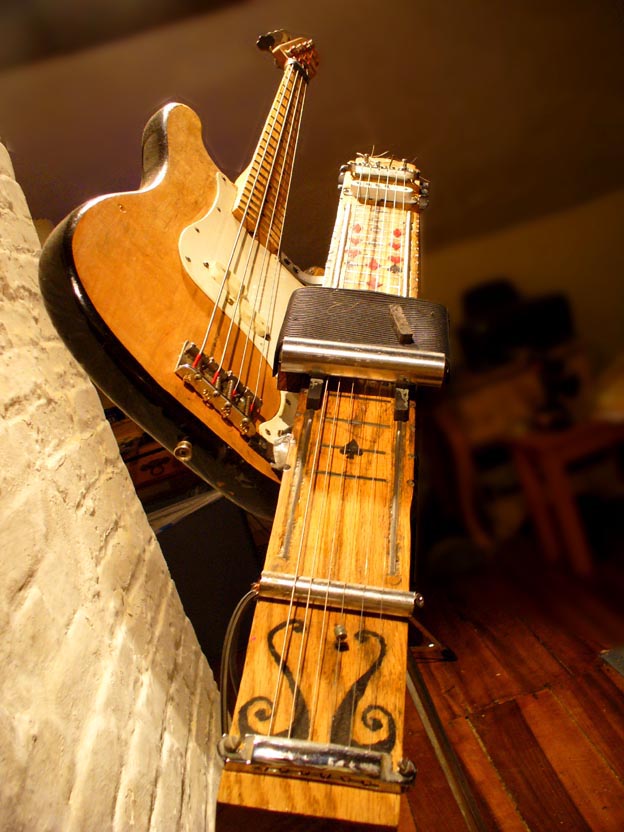
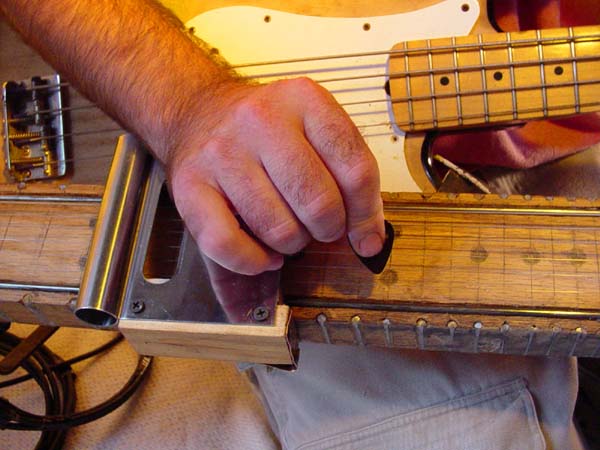
I first got the idea for The Egotar living in NYC back in the mid 90's. Frustrated with the shortcomings of midi keyboard element of the Swiss Army Bass (emulating slide guitar parts/sounds) I thought to myself .... ,..."why not commit a truly authentic act of self indulgence?". I set out to figure out how to play pedal steel guitar with one hand while playing bass with the other .... I figured that this could done fairly simply by mounting a slide on a carriage over the strings and reversing the action of the whole instrument. This would allow me to rest my palm on the carriage and "fret" and pick with the use of just one hand. At that, I set out to build the a prototype. The original rig was really clunky but sounded great from the start. I even managed to toss it on the back of a cart and go play in the subway and made a living for a summer when my band was on the rocks and my studio slow.
| ..... Here's how it works |
 |
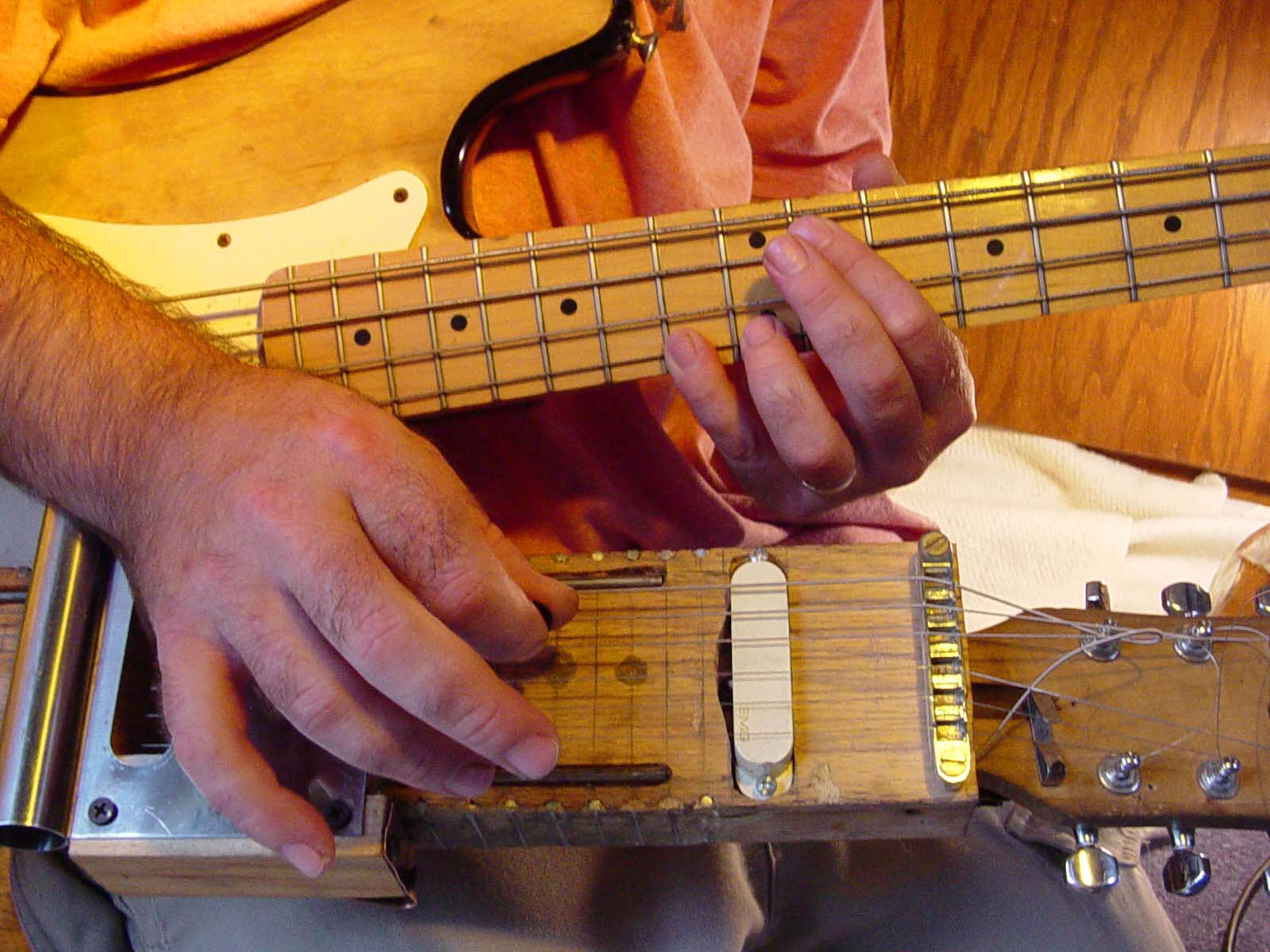 |
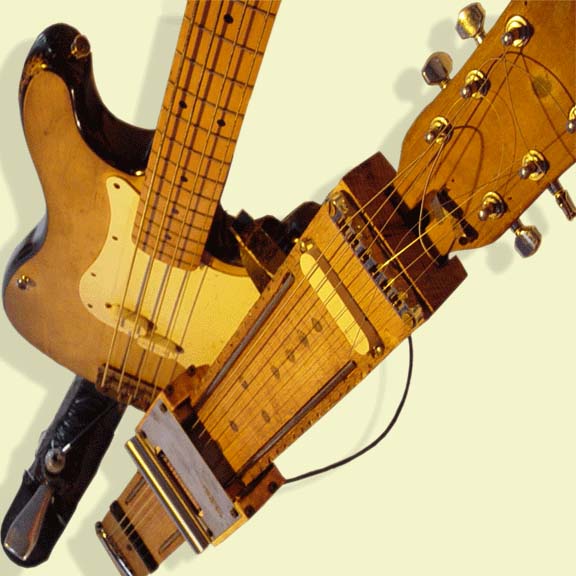
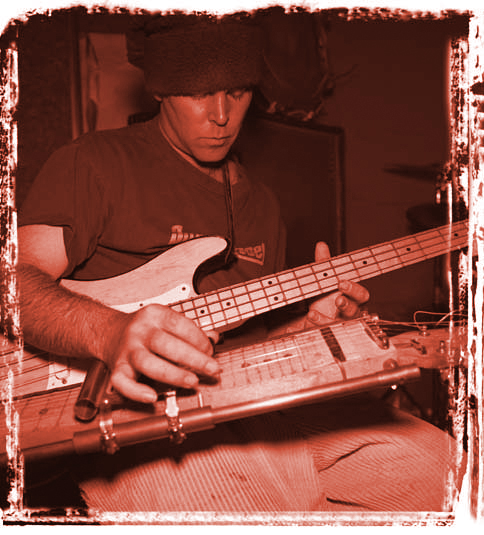
| Players right palm rests on lateral sliding carriage enabling single-handed slide guitar. | The bass guitar is played simultaneously using only the left hand employing a guitar technique known as hammer-ons . |
|
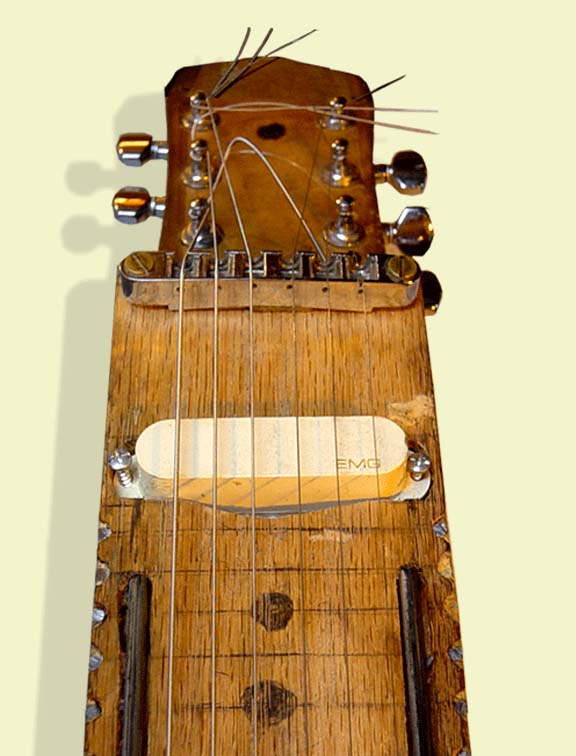
Unlike conventional guitars, the pickup is positioned toward the headstock, thus this instrument's tonal operation is reversed. In other words.......... it's bass ackwards. |
 |
 |
||
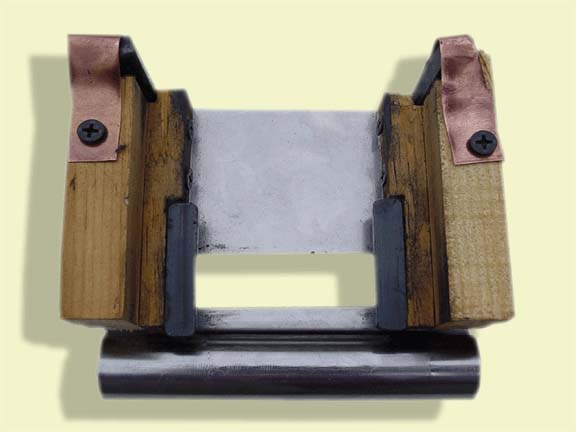
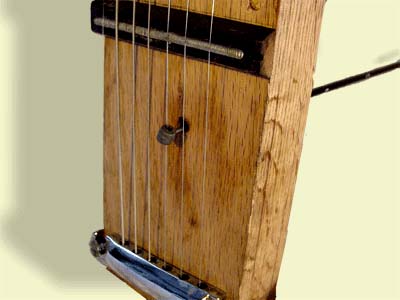
| Magnets on the underside of the slide carriage mechanism address the two long metal inlays on the face of the instrument keeping the slide in place. A pair of floating magnets addresses the smaller metal inlays (ok, they're nails) on either side of the instrument and act somewhat as frets. | ||||
|
|
||||
|
|
The original prototype
employed
drawer tracks mounted on either side of the "guitar" with corresponding wheels
on the slide carriage as a means of mounting the carriage over the
strings. I carved indentations into the tracks that jibed with
where the frets would be on a standard guitar. This allowed me to feel the
exact spot where the slide carriage should come to rest for any given note(s). In the
meantime, controlling the pitch of the "G" string in relation to
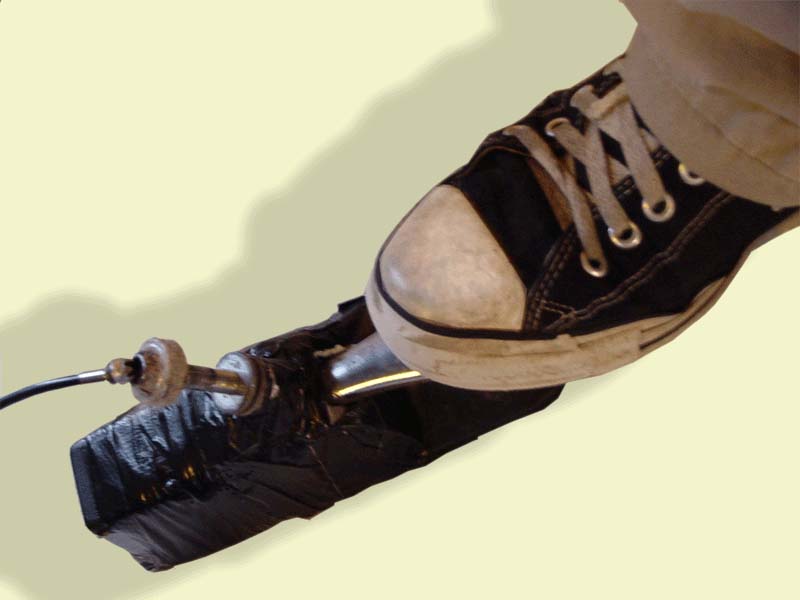
the other strings evolved from a crude drum pedal design to a more accurate
system that consists of a keyboard pedal, duct tape, and some extraneous
drum hardware. In the second prototype I replaced the draw tracks with
copper pipe (I was on a serious copper pipe tip at the time). The
mechanism functioned much more smoothly but was outdone by the current
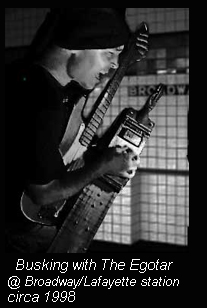
prototype described above. Busking in NYC was an interesting experience to say the least. I had to overcome a natural aversion to rolling into a park or subway platform and whipping out this freakizoic instrument and start playing it. I did the best for the Brooklyn-bound passengers at the Lafayette/Broadway stop. It's a relatively quiet station with low central ceilings (cozy almost). I would sit and play this improvisational, drugged, down-home country, Indian, Asian sounding stuff, keeping it as relaxing as possible for the crowd heading home evening. They appreciated it- I always went home with gobs of money. It was cool getting getting paid to learn how to play this thing I have great memories ...only in New York. My approach to the instrument has been to find the discipline & challenge to play numerous covers with multiple chord changes in order to become more proficient player as opposed to the improvisational -"shooting fish in a barrel- tripped out dreamscapes that comes so natural to the instrument. I particularly enjoy playing old Elton John tunes on the Egotar because of the wonderful chord inversions and familiarity to the listener. |
 |
|
| An earlier prototype employed a copper pipe for the slide mechanism. Jackson: take your shoes off you little commie |
| Every few years I pull this
thing out, dust it off, work on it, improve it and play it until my brain
bleeds and I get burnt out and throw the thing in the corner.
As
far as this series of recordings goes, I came up with a set of familiar
cover songs and
perform them in an intimate, stripped down way, sort of the opposite of
the Johnny Skilsaw thing. The Egotar is great for making up songs but my
focus here was expanding as a player while producing some familiar
music that's easy to listen for a change. I intentionally
chose songs I believe to be great songs, many of which
have complex chord progressions and huge poly chords that seriously
hurt my brain.... resulting in my dreaming up
The Fractal Harp
|